FLUID GOLD JOURNAL


Darwin Masbang
“Always Be Different”: Darwin Sanchez Masbang’s Harana of Beauty Between Pampanga and Paris

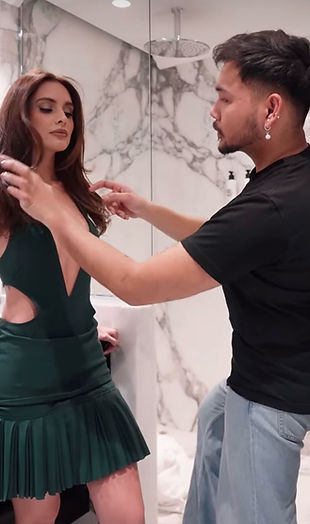
Images Provided by Darwin Masbang

Darwin Sanchez Masbang didn’t arrive in Paris through a beauty school pipeline or a carefully mapped career plan. He came from Pampanga by way of Dubai and Taiwan, chasing work, supporting family, and stepping into new countries whenever an unexpected door opened. In a small coworking salon in central Paris, this former practical nursing student and pageant kid has turned hair and makeup into his own kind of harana—a Filipino serenade of care and attention offered to a multicultural mix of clients, from French regulars to Asian migrants, each one invited to see themselves as already beautiful before his scissors even touch their hair.
Imagine a salon in Paris late in the afternoon, set right on a busy street where the light falls generously on mirrors and glass. The floor around one chair is scattered with cut strands of hair, dark and blond, straight and wavy—small traces of old selves left behind. A client shows her stylist a photo on her phone: a copper‑haired white woman from somewhere on the internet. She wants that color.
Behind her stands Darwin Sanchez Masbang, a Kapampangan hair and makeup artist from the Philippines who has made Paris his latest home. He looks at the picture, then at the woman in front of him. Copper, he knows, will not land the same way on her hair and skin. “It’s not for us,” he explains gently. “We are going to look like it’s an unfinished color.” Instead, he offers a shade that respects her natural depth and her reality of “Monday to Sunday” work, a color that can grow out softly without demanding constant maintenance. “You can go with me after six months, if you want, or a year, and then your hair is still okay,” he tells clients like her. “It doesn’t look like any demarcation of anything, it just grows.”
For Darwin, this is a kind of modern harana. In Filipino culture, a harana is the traditional serenade: a young man standing beneath a window with a guitar, singing up to the woman he loves, offering his sincerity under the scrutiny of neighbours and family. It is public and vulnerable, a request to be seen and accepted. Darwin’s version is quieter, played out under salon lights rather than the night sky, but the instinct is similar. With each cut and color, he sings a wordless message to the people in his chair: you are already beautiful; let me help you see it in a way that fits your life.
From Pampanga to Paris, by Way of Dubai and Taiwan
“Obviously, I’m from Philippine,” Darwin says, laughing lightly at the obvious. He grew up in Pampanga, a region known for its rich food culture and strong local identity. When people in the Philippines hear that someone is Kapampangan, they often picture someone who dresses well and carries themselves with a certain confidence. Darwin uses the casual Filipino word porma for this—a slang term that means to be well put‑together in how you dress and present yourself. “We don’t go out, we just go to the church and we know we need to do porma,” he says. “So, he’s from Pampanga, so for sure, he’s going to wear polo.”
As the only openly gay sibling in his family, Darwin grew into the role of quiet stylist at home, responsible for brows before church and fresh cuts for his mother. He joined a “group of gay friends” who did hair and makeup for local pageants. “We love pageants,” he recalls. “That’s the time that we’re starting to learn about hair and makeups.” At the same time, he followed a different track on paper: a two‑year practical nursing course, then a job as a sales associate and later supervisor at Crocs Philippines.
Ambition pulled him outward early. At nineteen he left for Dubai with his cousin, despite his mother’s worries. “You’re so young. I think it’s difficult for you,” she told him. His reply was simple and stubborn: “I know it myself, I can do it. What’s the difference? It’s just a place that you’re riding an airplane. What’s the difference of going to Manila from Pampanga with a bus?”
In Dubai, local norms made salon work difficult; many salons preferred to hire only women to touch female clients’ hair. Darwin turned instead to home‑service work and occasional freelance jobs, sometimes working in gloves that dulled the feel of his scissors and made his movements less precise than he liked. After about a year, another unexpected path opened. He accompanied his cousin to a recruitment interview for jobs in Taiwan; his cousin failed the height check, and on a whim Darwin stepped into the line instead. “We changed clothes, and then it’s me who passed the interview,” he remembers.
Taiwan became the setting for his first real salon of his own. While working and studying Chinese—enough to be promoted in his company and act as a bridge between Chinese managers and Filipino workers—he rented a small space. “That’s the time I really started doing real business about salon,” he says. “Before I just do home service, I just do with friends. But my friends told me, I think it’s time for you to step up, you know? Maybe you can risk a little bit.”
Paris, for Darwin, began as a visit, not a life plan. “Basically, I don’t have any plan to go to Paris, it’s just a plan to visit. But I met a guy in Paris,” he explains. He moved in May 2019, just before the pandemic. The timing could hardly have been worse. “I moved to Paris for more opportunities, and then COVID came,” he says. “I sacrificed myself, I have a good life in Taiwan, and then I have my own salon, and then it happened.”
Yet the city eventually worked its way into his heart. He rents a chair in a coworking salon in central Paris, works with “all nations, French, Lebanese, Latinos, Latinas, Filipino, Japanese, Korean,” and has come to relish the feeling of returning. “Maybe you just hate Paris, or you just love Paris,” he reflects. “The thing is, I love Paris. When I go on vacations, and then when I go back to Paris to go home, it’s like I’m having another vacation.”
Reading the Person, Not Just the Face
When someone sits in Darwin’s chair, he does not begin with bleach or a blow‑dryer. He begins with conversation. “Before I’m going to start, I’m always talking to the clients and then checking and observing their personality,” he explains. He looks at their face “to know my canvas,” but insists that “about 80%” of the work is guided by who they are rather than their features alone.
He pays attention to the small dissonances: the client who wants a glamorous, high‑maintenance look but moves with a shy, practical energy; the woman whose Instagram inspiration does not match her actual life in Paris. “Sometimes you look so glam and chic and then how you move, it’s not the same as the makeup,” he notes. In those moments, his task is to find a style that supports the person rather than the trend.
Asked if he ever feels he is editing someone’s life story rather than just their appearance, he answers without hesitation. “I think I’m highlighting the happiest moments of their life, especially for wedding,” he says. “And then erasing the past of their lives and bad things that happened in their lives.” In his hands, hair becomes a kind of text: some parts emphasized, some softened, but the story is still theirs.
Two Beauty Worlds in One Chair
Darwin’s sense of what suits someone has been shaped by living inside two different beauty cultures. In the Philippines, he saw how straight, rebonded hair and Western‑leaning looks became shorthand for attractiveness. “If you have a rebond hair and straight hair, you’re feeling beautiful,” he says. “That’s why everyone in Philippines, they have straight hair.” Clients bring him pictures of blond hair and balayage they see on Western women, and he understands why.
Paris has shown him another aesthetic rhythm. “They just do the ponytail and bun hair without anything,” he says. “It’s just messy, and then they’re still beautiful.” “Here they love volume,” he continues. “They don’t just stay with the thing that is trending right now, if they know they’re beautiful from what they’re doing.”
Holding these two worlds together gives him a particular authority when younger Filipinas ask for advice. Many are “so absorbed in trying to look Westernized,” chasing procedures and products that promise to remake them. He suggests another route. “Always be different,” he says. “Don’t go with the same people, what they’re doing, always be different, as long as you feel beautiful, you’re okay.”
He talks about trends like weight‑loss injections—“everyone go there”—and offers an alternative that values agency over fashion. “If you’re hesitating to get this one, so don’t get this,” he says. “If you know in yourself that you want to go to the gym, and you can do it normally and naturally, do it.” Then, with the tenderness of an older sibling, he adds: “Baby girl, always be different, in a good way, okay? It’s not always that everyone there is in a good path or the right path.” In a way, this too is harana—an intimate message offered openly, trusting that someone will hear themselves in it.
How Transforming Others Transforms Him
Over the years, Darwin’s work has taken him far from the small pageants of his early days. In Paris he serves as hair and makeup artist for a video and photography agency, working on commercials for brands that appear on YouTube and other platforms. During fashion week, he joins his boss backstage for runways at major houses, styling models whose images travel much further than the salon ever could.
Privately, he maintains a roster of clients that ranges from discreet Parisian businesswomen to Filipino celebrities who pass through Paris during fashion week.
These experiences have reshaped his understanding of himself. “Doing hair and makeup has changed my personality,” he reflects. The work has brought him into rooms he once never imagined entering. “Before, I thought it’s the end of the line of my career, you know? Like, I think I’m just, it’s just here,” he admits. “Now, if the president wants me to do the hair and makeup, I am not going to be intimidated anymore.”
On a day‑to‑day level, what he values most is the creative trust some clients offer. “It gives me happiness because they are letting me do my things, you know, like, no limitation,” he says. “They give me the freedom of doing my own art. It’s not like a daily routine, like autopilot things. It’s organic. What hair do you want? Surprise me.”
Representation, AI, and the Refusal to Panic
For Darwin, representation in beauty begins with how he sees the person in front of him before any product is applied. “Makeup is just secondary, it’s just a cover,” he insists. “It boosts your confidence. But I can say, before you’re going to sit in my chair, I can tell you that you’re already beautiful, and you’re already confident.”
He knows how much social media and global trends can distort self‑image. “You are just having some influence from social media, that you want to be someone like this or someone like this,” he says. His role is to counter that gently: “For me, you are already beautiful. We are just going to touch it up, we are just going to make it flawless.”
When asked about advances in technology, culture, identity politics, and AI, he remains calm. “I believe there is no advanced technology or any advanced AI that can change talent and skills of a person,” he says. “There is AI right now. But there’s a makeup artist. If AI works, why do they need us?”
Screens can make things look “beautifully in the screen, but not in person,” he points out. Virtual faces cannot replace the physical reality of hair, skin, and human presence. “There’s no such things as that,” he concludes; “there is still always like that” human formula and touch.
In a world where even serenades can be auto‑tuned and streamed, he trusts that there will always be room for live voices and real hands.
Beauty as Harana
When Darwin is asked to imagine his work as a serenade—serenada, harana—he does not start with theory; he answers with a line that sounds like both a lyric and a life philosophy: “You are beautiful no matter what they say.”
He admits it is something he has long told himself. “Because I only tell that to myself,” he says. “You’re always beautiful, no matter what they say, no matter what they do.” The classic Filipino harana envisioned a young man standing outside, risking ridicule to declare his devotion to a woman at her window. Darwin’s harana is different. It happens in a Paris salon, between a stylist and a client, often in a mix of French, English, and Filipino. The love he offers is not romantic but restorative: a way of returning people to themselves after years of comparison and doubt.
At thirty‑three, he does not narrate a sudden personal metamorphosis. “Right now, I’m already transformed,” he says with a modest shrug. “Maybe I just want to make it better and better and better.” His dreams are precise and grounded: to keep supporting his parents now that his sister has “already graduated” and is working; to give them small joys, like the Mother’s Day trip he recently paid for; to one day bring them from Palawan to Paris, even if only “for a month.”
Until then, his harana continues in the everyday rhythm of the salon. He sweeps the same floor, rents the same station, and welcomes a multicultural mix of clients—French, Asian, and many others—into his chair. Each appointment is a small act of trust: someone sits down, hands him their image, and lets him rewrite a few lines. The guitar of the old harana has become scissors and color; the window is now a mirror; the night sky has been replaced by the glow of Paris light. But the essence is the same.
With every careful suggestion, every refusal to erase someone’s origins for the sake of a trend, every gentle “Baby girl, always be different,” Darwin Sanchez Masbang keeps singing a Filipino love song in the heart of France—a harana of beauty that crosses borders and quietly insists: you are already beautiful, and you deserve to be seen on your own terms.


Images Provided by Darwin Masbang