FLUID GOLD JOURNAL


Ron Yuan
A Life Like a Serenade: Ron Yuan and the Integrity of Transformation

Images Provided by Ron Yuan

A life like a serenade does not unfold in a straight line, and neither has Ron Yuan’s — especially as an Asian American actor coming of age when faces like his were rare on screen. His career has never been a sprint toward celebrity, but a slow, stubborn composing of a life in the arts: a boy slipping off to rehearsals in New York, a working actor forcing open space in rooms that were not built with him in mind, a performer who disappears so completely into each role that audiences often do not realize they have been watching the same man. Along the way, he has been soldier and prince, doctor and gangster, weapons engineer and emperor — and, in The Mongol Khan, Archug Khan, a ruler whose power is measured not only in conquest but in conscience. Through it all, Yuan keeps his focus on the work itself: craft over noise, integrity over image, each performance another quiet note in a serenade that has lasted a lifetime.
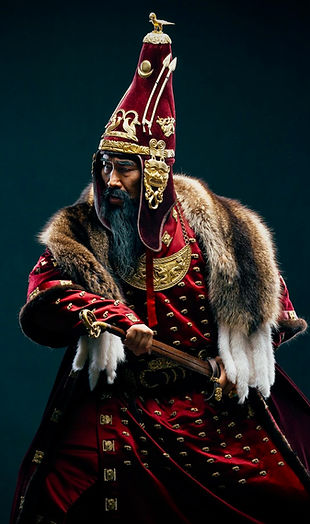
When Ron Yuan arrived in Mongolia to prepare for Mongol Khan, he was stepping into one of the production’s central roles: Archug Khan, the ruler he would go on to portray in the Singapore staging of the play in 2024. What he encountered was a production of extraordinary scale, one he later described as “like Cirque du Soleil meets Shakespeare.” It was not simply a return to the stage after years of screen work, but a return to a part of himself — the New York theater child who had first learned to love performance as a living, physical act of commitment.
At the center of that experience was Yuan’s performance as Archug Khan — a leader burdened by duty, betrayal, and the painful consequences of power. In Yuan’s telling, Archug was not only a monarch but a moral study: a man trying to lead honorably while navigating incomplete truths, emotional wounds, and the consequences of trust. That tension makes the role a fitting entry point into Yuan’s broader artistic life, one defined not by spectacle alone, but by discipline, humility, and a rare fidelity to craft.
What emerges in conversation is not simply the portrait of a veteran actor, but of a genuine artist — one whose career has been built on integrity rather than self-display, and on a willingness to disappear completely into the demands of the work.
The Heart of Power
In Mongol Khan, Yuan played Archug Khan, a ruler whose authority is tested by deception, loyalty, and the moral consequences of judgment. Yuan was drawn to the role not because it offered grandeur, but because it offered contradiction. “I found it very exciting,” he says. “For me, a chance to, like, provide more layers for a character.”
Rather than flattening the ruler into an emblem of authority, he sought to reveal the emotional currents underneath the crown. “I think by grounding yourself in the true emotions makes him naturally more sympathetic,” Yuan explains. “He has done certain things for love. He has done certain things that he felt were righteous for his nation.” In his hands, Archug becomes a man whose failings are inseparable from his conscience. His errors do not come from indifference, but from the tragic vulnerability of someone trying to act justly in a world shaped by betrayal.
That inner code is what most interested Yuan. “He rules from the heart,” he says. It is a phrase that resonates beyond the role itself, because it also describes the values Yuan continues to return to in his own life and work. “If we had leaders that try to rule righteously from the heart and not with alternative motives of greed and other stuff in power,” he reflects, “I think we would all be in a better place globally.”
There is nothing cynical in the way he says this. Even while acknowledging that such leadership would still be imperfect, Yuan remains deeply invested in the possibility that strength and sincerity can coexist. That belief gives Archug Khan its emotional force, and it gives Yuan’s performance its quiet gravity.
From Invisibility to Presence
Yuan’s understanding of power is inseparable from the landscape in which he grew up. As an Asian American kid in Manhattan, he came of age in a media culture where faces like his were scarce. “Yeah. It absolutely fueled me. Absolutely, without a doubt,” he says of that absence.
Bruce Lee was one of the first figures to make a profound impression on him, though not simply for martial arts. Yuan speaks of Lee’s presence, his magnetism, and the revelation that he, too, had once been a child actor. He also looked elsewhere for models of dignity and command. “Who was mine? Sidney Poitier,” Yuan says, recalling how many Asian American performers of his generation looked to Black actors as early examples of what centrality on screen could look like.
Today, younger generations inherit a different cultural landscape — one with more Asian protagonists, more international crossover, and more visible forms of representation. Yet Yuan remains careful to distinguish visibility from artistic depth. “Don’t ever forget the craft,” he says. For him, the danger is not simply underrepresentation, but a culture that prizes exposure over substance.
“The craft is the star, not us,” he says. “So we have to keep feeding it.” The line feels central to his philosophy. In an era increasingly driven by metrics, followers, and image, Yuan continues to insist on the harder, slower work of becoming — not merely appearing.
The Work Behind the Image
One of the most striking things about Ron Yuan’s body of work is how fully he vanishes into it. With each new role, he does not simply arrive as a recognizable star carrying the same mannerisms from one project to the next. He transforms. The face, the posture, the rhythm, the energy — each becomes so specific to the character that viewers often do not realize they are watching the same actor.
Yuan himself acknowledges this pattern with a mixture of humor and acceptance. “A lot of people [say], I didn’t realize that was you,” he says. He adds that he has “always wanted to just be different, look different, do different stuff,” and that this instinct has been so strong that even agents have urged him to keep a more consistent appearance so audiences would recognize him more easily.
That is precisely what makes his work so unusual. There are performers who remain fundamentally the same in every role, preserving a familiar persona that travels from project to project. Yuan is not that kind of actor. His gift is transformation, and the record of his screen work makes that plain. He played Master Sgt. Qiang in Disney’s Mulan; Prince Nayan in Netflix’s Marco Polo; Quon Zhang in The Blacklist; Ryu Tom in Sons of Anarchy; Lt. Peter Kang in CBS’s Golden Boy; Dr. Evan Zao in CSI: NY; Yeong, the main weapons engineer, in Independence Day: Resurgence; and David Park in Fast & Furious. Seen together, those roles reveal the scale of his range. He can move from imperial command in Mulan to political intensity in Marco Polo, from procedural sharpness in CSI: NY to menace and unpredictability in Sons of Anarchy, without ever seeming to repeat himself.
From the audience’s point of view, that is no small feat. It is an actor’s actor skill: the ability to reshape not only appearance, but presence. That ability is not cosmetic. It reflects rigor, imagination, and a profound respect for character as something to be built from the inside out.
The same seriousness shapes his work in action and directing. He speaks of being “very physical” from an early age, combining dramatic performance with dance, stage combat, and choreography. Later, when acting work for Asian American performers remained limited, he designed action sequences to support himself, and in doing so sharpened his understanding of camera, movement, and visual storytelling. “It really educated me on how to shoot,” he says.
That education became part of a larger artistic identity. Yuan did not approach choreography as an accessory to performance, but as another dimension of storytelling. He studied framing, learned the language of cinematography, and developed the visual instincts that would help lead him toward directing. What stands out is the continuity of purpose: whether acting, choreographing, or directing, he speaks always from the same place — a commitment to doing the work truthfully and well.
That commitment is still visible in his present-day work. In May 2026, Yuan and his brother Roger were featured by the Directors Guild of America’s Asian American Committee in “Filming the Impossible: A Celebration of Asian Action Filmmakers,” where they spoke about best practices for directing action and presented a live demonstration. The moment feels less like a side note than a continuation of everything the interview reveals: the actor who studied movement, the choreographer who learned framing, and the director who now helps articulate the craft for others.
That integrity also extends to the way he talks about Mulan. “We were honored. All of us were honored… to be a part of that project,” he says. He remembers the sense of possibility surrounding the film and the hope that it might mark a cultural turning point. Even when discussing the uneven pace of change in Hollywood, his emphasis remains on continued effort, collective responsibility, and the need to keep creating work of substance.
Family, Roots, and the Long Song
If Yuan’s public life is defined by transformation, its roots lie in a private struggle for permission. “My family didn’t want me to be an actor, so I couldn’t go to school for it,” he says. Instead, he built his path quietly, taking classes and rehearsing while telling his family he was staying late for schoolwork.
His grandparents had envisioned a more traditional future for him — “doctor, politician, architect” — but Yuan already knew, very early, what called to him. “I knew that I wanted to act, since I was really, really young,” he says. That conviction remained intact even when it had to be carried in secret.
His reflections on his brother Roger are especially moving. Though both eventually found their way into the industry, Yuan describes a long period in which the two moved through life with a certain emotional distance, shaped by a demanding upbringing and by personal experiences they only later began to share with one another.
Only later, in midlife, did that distance begin to dissolve. “We’re closer now than we’ve ever been,” he says.
There is a generosity in the way Yuan tells this part of the story. He does not frame family in bitterness, but in complexity — as a place of duty, silence, love, expectation, and eventual recognition. He speaks tenderly of his parents, and of the way his father, especially later in life, became freer to express pride in what his sons had built. “After they left, that was when you could see that my father was happier to freely express… that he was proud of us and what we did.”
And then there is the word that hovers over the whole arc of his life: serenade. Yuan reaches for Cyrano de Bergerac when asked what the word means to him. For readers unfamiliar with the story, Edmond Rostand’s classic play centers on Cyrano, a brilliant, eloquent, deeply sensitive man who loves Roxane but believes himself too outwardly unattractive to win her openly. Instead, he lends his words to the handsome but inarticulate Christian, helping another man speak the love Cyrano himself cannot claim.
That is why the story moves Yuan so deeply. “Although Cyrano was in love with her, and was in so much pain, but he wanted her to be happy,” he says. For him, that act of giving — of offering language, beauty, and feeling without needing recognition for it — is a form of serenade.
The comparison feels unexpectedly exact. So much of Yuan’s career has carried that same quality: a long devotion to the work itself, often without the full recognition that should accompany it, and yet never reduced by that fact. “Was it frustrating on that journey? Oh, hell yeah,” he says with candor. But he does not leave the thought there. “I think it made me stronger. I think it gave me more colors, not just… in my journey of the characters I play, but also in my life.”
That may be the clearest way to understand Ron Yuan — not simply as a working actor, or even as a symbol of endurance, but as an artist of uncommon integrity. He transforms without vanity, persists without bitterness, and returns again and again to the values that first shaped him: humility, discipline, depth, and heart. In an industry often drawn to surfaces, that kind of artistry does more than endure. It sings.


Images Provided by Ron Yuan